
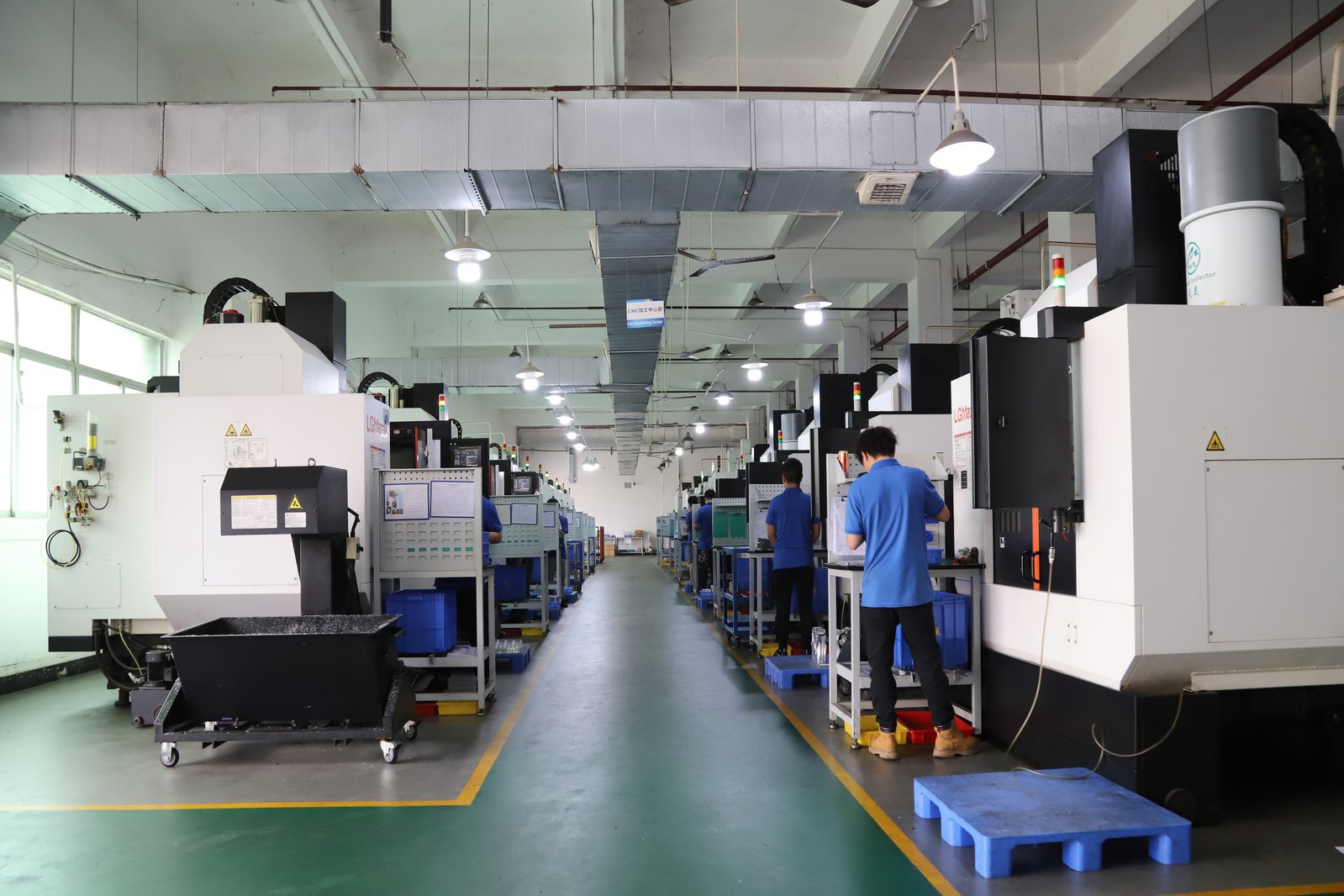
Almost any prototyping conversation starts with a false choice: machine it or print it. In practice the deciding factors are the question the sample must answer, the quantity you need, and the material the design will finally use. A China CNC prototype makes sense for a large share of functional samples because it uses the real production alloy and real machined tolerances, but printing, vacuum casting, and molding each own a corner of the map. This article gives you the decision logic, with the numbers that matter, so the process choice is made on engineering grounds rather than habit.
1. When does a China CNC prototype beat 3D printing for a functional sample?
Start with what the sample has to do. If it will be assembled, torqued, pressed, tested, or carried on a product that ships, it needs the properties of the material on your drawing, and a machined part is the shortest path to those properties. CNC machining starts from wrought bar, plate, or billet, so the microstructure, strength, and corrosion behavior are those of the actual grade: 6061-T6 aluminum, 304 or 316L stainless, 17-4PH, Ti-6Al-4V. Additive parts, by contrast, are built layer by layer and carry a different microstructure, a rough as-built surface, and in many cases lower fatigue performance unless they are hot isostatically pressed and machined.
Tolerance is the second argument. Machining holds ±0.003 mm in milling and turning and ±0.002 mm in precision grinding, with Ppk ≥ 1.67 at the initial study on critical characteristics and Cpk ≥ 1.33 on general characteristics. Capability is reported per characteristic: every report names the feature, its tolerance band, the sample size, the sigma method, and the study window. — numbers that matter when the prototype is a bearing housing, a seal face, or a mating bracket. A printed part that is then machined on critical features starts to look a lot like a machined part with extra steps. When the drawing calls for tight geometry in a production alloy, the comparison is over before it starts.
There is also an evidence difference worth pricing in. A machined prototype can ship with a material certificate for the stock actually cut, a dimensional report against your drawing revision, and process data when the tolerance matters. A printed part cannot offer a certificate for a grade that was never wrought. If the prototype will be reviewed by an auditor, or if it is the seed of a regulated production program, that record is part of what you are buying, and it is the part of the price that printing does not include.
2. Where does 3D printing genuinely win the comparison?
Printing is not a weaker version of machining; it is a different tool, and it wins on geometry that no cutter can reach. Internal conformal cooling channels, lattice structures, organic enclosures, and single-piece assemblies with captive features are either impossible or very expensive to machine. If the prototype exists to validate exactly that geometry — airflow through a printed channel, the feel of a lattice, the snap of a living hinge in a polymer — then printing is the honest choice, and the part should be printed even if the same shop could machine it.
Polymer printing also wins on speed for local one-offs. If you are in the same city as a printer and need a fit check tomorrow, the SLA or SLS part arrives while a China-sourced machined part is still on an aircraft. The trade is explicit: local printed polymer today, versus machined production material in a few days. For appearance models, ergonomic checks, and internal-geometry studies, that trade points to printing. The parts page of this site shows the kinds of functional components where machined samples justify the wait.
A middle path deserves a mention: print for speed, then machine when the design locks. Many hardware teams iterate an enclosure in printed polymer while the load-bearing bracket is machined in parallel, then converge on machined samples for the final validation round. The cost is two vendors instead of one, but the elapsed time can beat running every iteration serially on a single process. Ask the machining supplier whether it will work from your printed model as a fixture aid on complex geometry — it can save a setup or two and shorten the last validation cycle.
3. How does metal 3D printing compare with CNC on cost and lead time?
Metal printing — DMLS or SLM — gets quoted against machining more often than it should, because the per-part price hides real follow-on work. A printed metal part normally needs support removal, heat treatment, hot isostatic pressing in demanding applications, and machining of the critical surfaces and sealing faces. Add the powder itself, which is expensive, and the as-built surface, which is rough enough that functional surfaces are almost never left as printed. The line item that looks reasonable at the quote stage grows once the part is made usable.
Where metal printing earns its keep is low quantities of parts with internal geometry that cannot be machined in one setup, or designs still changing every few days where tooling or fixtures would be wasted. The honest decision rule: if the final design will be machined or cast, prototype it machined or cast so the sample and the production part share a process. If the final design will itself be printed, prototype it printed. A printed prototype of a part that will be machined in production answers fewer questions than the same spend on a machined sample.
4. Which material should the prototype use — the production grade or a stand-in?
Material selection at the prototype stage comes down to one question: what is the sample for? If the goal is to validate geometry, fit, and assembly sequence, a stand-in material with similar machinability can cut the bill sharply. A 6061-T6 sample standing in for a 7075-T6 production design, or a 304 sample for a 316L part, validates the envelope at a fraction of the cost. If the goal is to validate material behavior — strength, stiffness, corrosion, fatigue, thermal — the sample must be cut from the actual grade and condition on the drawing, with the material certificate to prove it.
| Prototype goal | Sensible material choice | Reason |
|---|---|---|
| Fit, assembly, and envelope | Stand-in alloy with similar machinability | Validates geometry at lower cost; note the stand-in on the drawing |
| Mechanical or material testing | Final grade and condition, certificate included | Sample properties must match production or the test is meaningless |
| Surface finish and anodizing trials | Same alloy family, same temper | Finish and anodize response vary with alloy and heat treatment |
| Thermal or electrical testing | Final grade; check conductivity spec | Conductivity differs across alloys in the same family |
Whatever you choose, say it in the RFQ. A shop cannot challenge a stand-in it does not know about, and a drawing that names a production grade with a sample cut from something else needs the substitution stated in writing so the quality record stays honest. Machined prototypes also give you a material certificate for the stock actually cut, which a printed sample cannot provide for the same grade.
5. How should you compare a China CNC prototype with a local alternative on time?
Lead time comparisons are only fair when they run the whole path. A China-sourced prototype runs through quoting, programming, machining, inspection, and freight; a local option has no freight leg but may sit in a queue for machine time. In practice the machining itself takes days either way, so the deciding terms are the supplier's workload and the shipping leg — typically a few days door to door from South China by air. The honest comparison is elapsed days to a part in your hand, with shipping included in the quote.
There is a second, less obvious time factor: iteration. Prototypes are rarely right on the first pass, and the number of design cycles often matters more than the duration of any single one. When the supplier is in another time zone, batch your changes rather than drip-feeding them. Send revision two together with revision-one feedback, and ask the machinist to quote the delta against the original model. A China CNC prototype supplier that responds within a day and turns a revision in days will often finish your whole iteration loop faster than a local shop that is fast on paper but busy in practice. You can see the service scope and finishing options that affect each cycle on the services page.
6. When does vacuum casting make more sense than machining multiples?
Once the quantity climbs past roughly a dozen parts and the material is a polymer, vacuum casting enters the comparison. The process starts from a CNC-machined master — usually the very prototype you would have ordered anyway — then builds a silicone mold around it and casts production-like polyurethane parts in the mold. The strength of the process is bridge quantities: from a dozen to a few hundred parts that need molded surfaces, molded-in color, or a specific resin, delivered before you commit to the cost and lead time of steel injection tooling.
The catch is fidelity and geometry. Vacuum-cast parts reproduce detail well from a good master, but deep undercuts and thin cores stress the silicone mold, and the mechanical properties are those of the cast resin, not an injection-grade polymer with the same trade name. Treat the process as a bridge, not a substitute: the master is machined (so a China CNC prototype is still in the chain), and the cast parts let you test fit, finish, and function in near-production form. For one-off metal prototypes the process is irrelevant; for polymer parts heading toward molding it can save a real share of the development budget.
7. When should injection molding enter the decision at all?
Injection molding earns its place at the volumes where the steel tool is amortized — typically thousands of parts or more, depending on part size and material. Before that point the tooling cost dominates, and it makes no sense to quote molded parts for a validation batch. The useful pattern for a buyer is to prototype in CNC, validate the design, and keep the machined sample as the reference while the mold is built. Many shops will machine the mold cavity from a model that was already proven as a prototype, which shortens the molding ramp.
The prototyping decision, then, is rarely "machining or molding." It is a sequence: CNC for the early samples, vacuum casting for bridge quantities of polymer parts, and injection molding only when the demand curve supports the tool. Buying a China CNC prototype at the start of that sequence does not waste the spend — the sample becomes the master for casting, the reference for the mold, and the benchmark part that the molded output is measured against. The sequence is only expensive when a buyer jumps straight to tooling without the machined sample to de-risk the geometry.
8. Which tolerance and finish expectations should differ across the processes?
Each process carries its own dimensional and surface reality, and comparing them on a single number is how buyers get misled. Machining holds the tightest envelope: ±0.003 mm milling and turning, ±0.002 mm grinding, with Ppk ≥ 1.67 at the initial study on critical characteristics and Cpk ≥ 1.33 on general characteristics. Capability is reported per characteristic: every report names the feature, its tolerance band, the sample size, the sigma method, and the study window and finishes that reach whatever the drawing calls for — as-machined, bead-blasted, anodized, plated. Printed parts come out of the machine with a layered surface that normally needs machining on functional faces. Cast parts inherit the shrinkage of the resin or metal and the accuracy of the mold. There is no process that is the most accurate everywhere; there is only the process whose accuracy matches the feature that matters.
Write the drawing so the process has a fair target: call out the tolerances and finish only where function needs them, and let the supplier state what its process delivers on the rest. When you compare quotes across processes, compare like for like — the same drawing, the same inspection requirement, the same material intent. A machined sample and a printed sample of the same part are different products with different evidence, and the decision between them should be made the same way the production decision will be made: on material, tolerance, and volume. The quality page documents the inspection evidence that travels with machined prototypes when the process comparison matters.
The buyer's rule of thumb: let the prototype's purpose pick the process. Geometry nobody can machine, print it. Polymer bridge volumes, cast it from a machined master. Functional parts in a real alloy, machine them. When in doubt, machine, because a machined sample in the production material answers the most questions, and it stays useful as the master and reference for every process that follows.
Frequently Asked Questions
When is a China CNC prototype a better choice than 3D printing?
When you need the real production alloy, machined tolerances, or a part that will be tested or used rather than looked at. CNC parts come from wrought bar or plate, so properties match the specified grade, and milling and turning hold ±0.003 mm with precision grinding at ±0.002 mm. Use printing for geometry checks where material does not yet matter.
When does 3D printing win over CNC prototyping?
For one-off polymer fit checks, lattice or internal-channel geometry that no cutter can reach, and local same-day delivery when you are not sourcing from China. As soon as the design needs production materials, surface quality, or a meaningful mechanical test, machining takes the comparison back.
Which process is cheaper for a low-volume functional run?
For one to a few parts, machining and additive are usually close on price, and machining wins on material and tolerance. From a dozen to a few hundred polymer parts, vacuum casting takes over. Injection molding only becomes the cheapest option at volumes that justify steel tooling.
Can I prototype in a different material from production?
Yes. A 6061 stand-in for another aluminum, or a machined master for a cast or molded part, is routine. Match the sample material to the question: geometry and fit checks tolerate a stand-in; material or mechanical validation requires the real grade with its certificate.
How do I compare lead times when sourcing a prototype from China?
Compare elapsed days to a part in hand, shipping included. Machining takes days either way, so the freight leg and the supplier's workload decide the total. Batch design changes to shorten the iteration loop, and ask for the delta quoted against the original model.
What is vacuum casting best used for?
Bridge quantities of polymer parts — roughly a dozen to a few hundred — cast from a CNC-machined master in a silicone mold. It delivers molded-like parts in production resins before steel tooling is justified, with the caveat that deep undercuts need attention at mold design.
Is CNC prototyping in China slower than a local machine shop?
Not necessarily. Machining takes a few days either way, so the freight leg decides the total — typically a few days door to door from South China by air. Ask for shipping in the quote and compare elapsed days, not just price, before assuming local is faster.
Unsure which process fits your sample?
Send the model and the prototype's goal through the contact page — the review will tell you which process answers your question and what the machined option would cost.