
- Legal manufacturer: Dongguan Zhuohang Ltd, registration 91441900MA4UWT6X39 (formerly Zhuohang Precision Machining Factory).
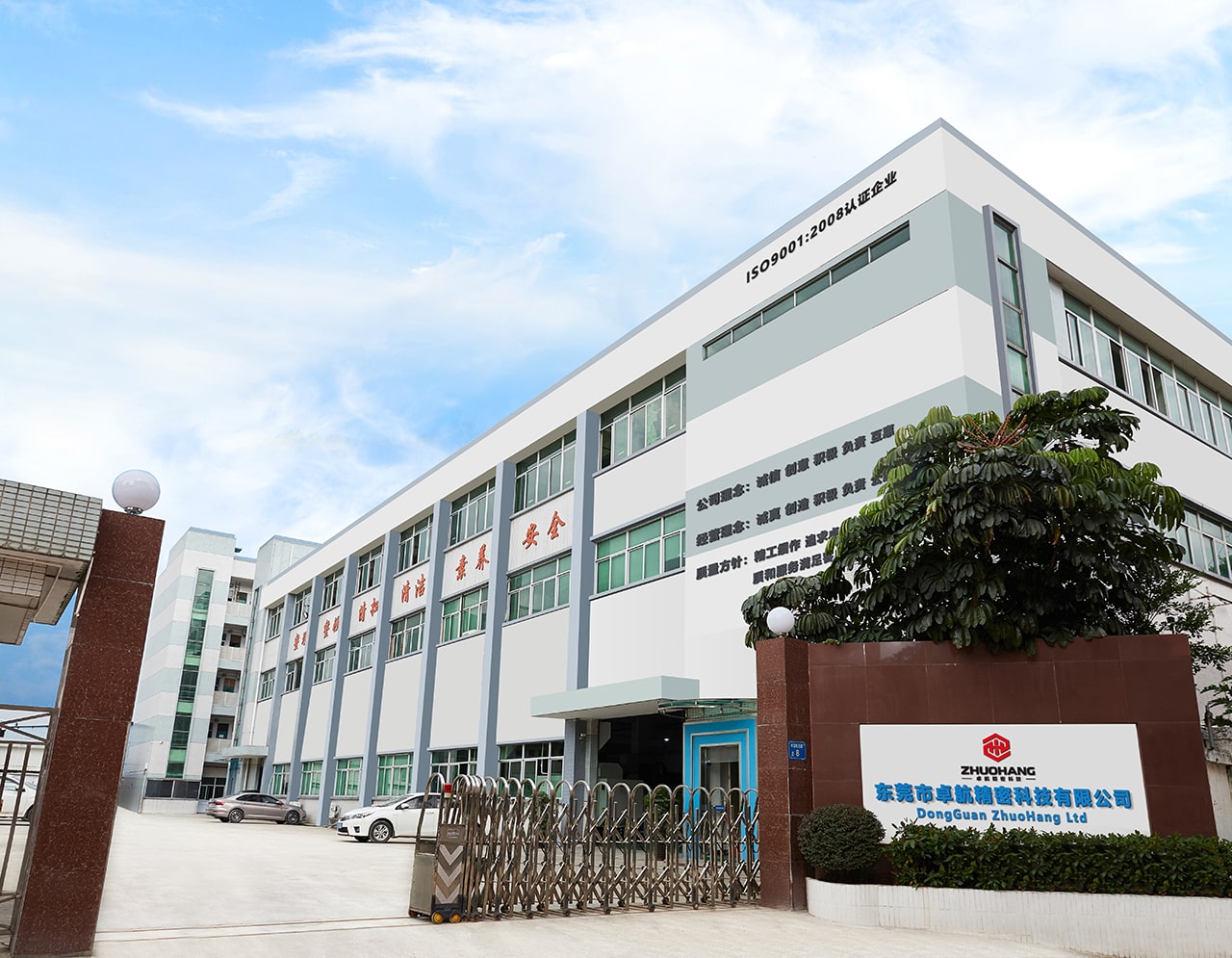
- Facility: 6,800 m², two buildings — production/QC/office plus staff dormitory and canteen.
- Staff: 100+, of whom 80%+ are skilled technicians.
- Machines: 100+ production machines (Brother SPEEDIO, Mazak VCE/VARIAXIS/INTEGREX/QT, Citizen Cincom, Star SR, Tsugami).

What is the legal entity behind the brand?
China CNC Prototype is a machining brand, not a shell. The legal manufacturer is Dongguan Zhuohang Ltd, registration number 91441900MA4UWT6X39, formerly operating as Zhuohang Precision Machining Factory and Dongguan Zhuohang Ltd The name on the certificate, the name on the invoice, and the name on the door are the same, and if they ever are not, you should ask why before paying.
Founded in 2005, the company is headquartered in Hengli Town, Dongguan City, Guangdong Province, China.
The history matters because it is checkable. A brand born last year can still be legitimate, but a registered entity with a verifiable founding year has a paper trail — audits, renewals, a physical address — that a shell does not. The founding year 2005 is a fact, not a marketing line, and it is the kind of fact you confirm rather than take on faith.
The name on the door matters for one more reason: when you pay, the invoice should come from the entity that holds the certificate and owns the floor. Three matching names — certificate, invoice, and door — are the short version of the entire due-diligence argument on this page.
What does the physical facility look like?
The campus holds two buildings: one for production, inspection, and offices, the other for staff dormitory and canteen — 6,800 m² in total. The layout matters for one practical reason: manufacturing, metrology, and management sit under one roof, so a part does not travel between sites between operations and accountability does not scatter.
When you stand in it, the scale reads as a working factory, not a showroom. Machines run, parts move, and the inspection bench sits in the middle of it all, which is the layout you want to see before you commit a production program to it.
Which machines run on the floor?
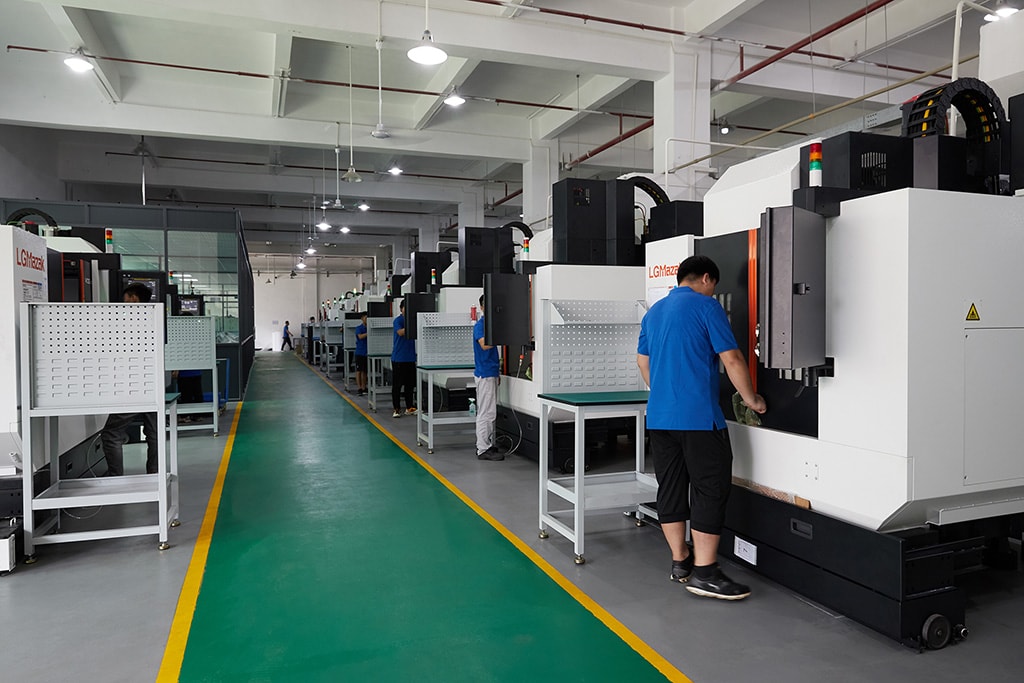
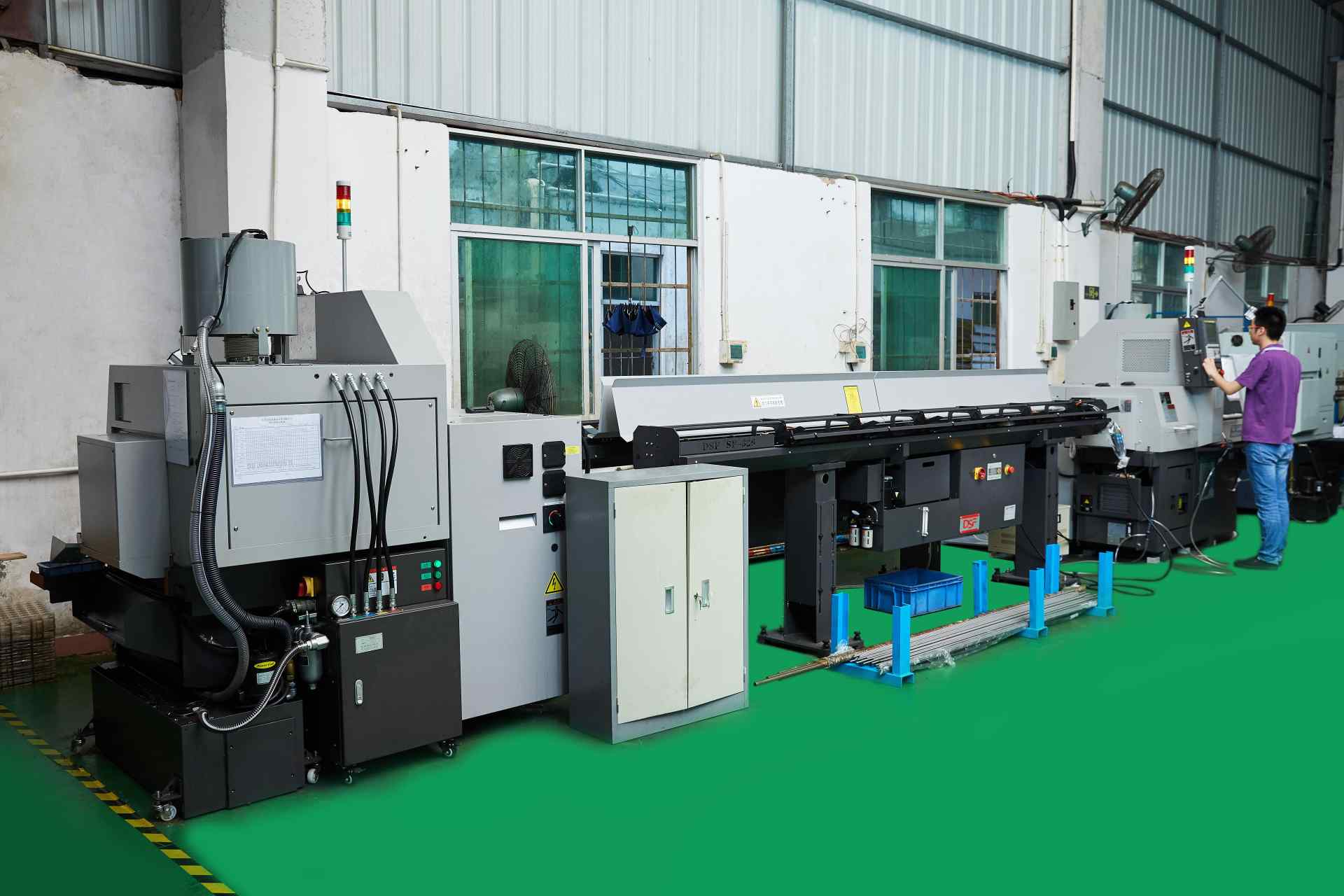
A real factory names its machines; a trading desk recycles brochures. The floor runs 100+ production machines across the metal-cutting range:
| Machine role | Representative families | Count |
|---|---|---|
| High-speed vertical machining | Brother SPEEDIO S500Z2N / S700Z2N | 3-axis 50+ / 4-axis 20+ / 5-axis 20+ |
| Heavy vertical machining | Mazak VCE-430AL / VCE-570CL | |
| Mill-turn / multi-task | Mazak QT-COMPACT 200MSY L, INTEGREX i-H, VARIAXIS i, Brother M300X3 RD / M200X3 RD | Multi-task centers |
| Swiss-type turning | Citizen Cincom A20, Star SR-32JII, Tsugami B0205 | 25+ lathes total |
| Precision grinding | Surface / centerless / cylindrical | 7+ grinders |
Brand whitelist, stated for a reason: naming actual models lets a buyer verify the equipment against the physical floor during an audit — the same check a trading company cannot pass.
Beyond the brand names, the counts matter because they bound what the shop can promise. A single five-axis machine is a capability; a floor of them across milling, turning, and grinding is one that can take your prototype and your production run on the same equipment.
Which certifications does the factory hold?
Three certificates, issued against the legal entity and verifiable with the registrar:
| Standard | Certificate number | Scope |
|---|---|---|
| ISO 9001:2015 | 116024/A/0001/UK/En | Machining of metal parts |
| IATF 16949:2016 | 131941/A/0001/SM/En | Manufacture of CNC metal machining parts (excludes product design, Clause 8.3) |
| ISO 14001:2015 | 116024/B/0001/UK/En | Environmental management related to machining of metal parts |
Three certificates also cover three different buyer concerns, which is worth stating plainly: ISO 9001 covers whether the quality system exists, IATF 16949 covers whether it is automotive-grade, and ISO 14001 covers whether the environmental side is managed. A shop that holds all three is managing the whole operation, not just the cutting.
How does the factory protect your intellectual property?
For you sending drawings, IP protection is part of compliance, not an afterthought. Drawings and files are never shared with third parties without written permission, NDAs are signed and returned on request, sensitive paper files are stored in a smart-lock space, and digital data lives on encrypted drives. Labor and ethics compliance follow the same discipline: no forced or child labor, employment contracts on day one, social insurance for all staff, and lawful working hours.
IP protection is also a question of who can see the file. In a shop where the floor, the office, and the inspection bench share a building, the drawing moves a short distance between the people who need it, and the smart-lock and encrypted-drive rules cover the rest. Ask how many people touch your file; the smaller the number, the smaller the leak surface.
What should you check on a factory visit?
A visit is the highest-value due-diligence step you can take, and it takes an hour if you know what to look for:
- The certificate on the wall matches the number. Cross-check the name and number against what the registrar lists.
- The machines match the list. Walk the floor and confirm the models and counts.
- The inspection bench is real and in use. A CMM gathering dust is a prop; one running jobs is a control.
- People can read a drawing. Ask an engineer how they would machine a specific feature — the answer reveals depth.
- The documentation is traceable. Ask to see a real SPC chart and a material certificate from a recent job.
Visits and audits are welcome. The factory is at No. 8, Shuibian Songyuan Road, Hengli Town, Dongguan, Guangdong, China 523470 (GPS 23.048947, 113.990605).
A short version of the audit, for buyers who cannot travel:
- Ask for a dated floor photo with the day's paper in it, not a stock image.
- Ask for a live video walk of the machining cell and the CMM bench.
- Ask for the certificate numbers and check them with the registrar.
- Ask for a sample SPC chart and a material certificate from a recent job.
A shop that can produce these on request is a shop you can audit from your desk until you can stand on its floor.
Why does the legal name matter more than the brand name?
A brand is a marketing choice; a legal name is who you can hold accountable. A supplier can print any brand on a website and route the order through a different company you have never heard of. The legal entity is the one that signs the invoice, holds the certificates, and answers in a dispute, so it is the name you actually need.
China CNC Prototype is a machining brand; the legal manufacturer is Zhuohang Precision Machining Factory. When the brand and the entity are the same operation, the brand is a label on the door, not a mask over it. That is the consistency to look for, and it is the first thing to confirm before you send a drawing.
How do you confirm a registration number is real?
A registration number is a fact you can check, not a claim you have to trust. The number 91441900MA4UWT6X39 identifies Dongguan Zhuohang Ltd, and it can be looked up against public records to confirm the name, the status, and the registered address. A supplier that will not give you the number, or gives one that resolves to a different name, has answered your question.
The check takes minutes and costs nothing. It is the cheapest due-diligence step there is, and it catches the most common failure mode: a trading desk using a real factory's name without being that factory. Pull the number, match the name, and move on to the floor.
How do you read a machine list and verify it against the floor?
A machine list is only evidence if the floor matches it. The point of naming models — Brother SPEEDIO, Mazak VCE and INTEGREX, Citizen Cincom, Star SR, Tsugami — is that you can walk the floor, read the nameplates, and confirm the counts. A trading desk recycles brochure photos because it cannot do that.
| What the list should include | What it proves | How you verify it |
|---|---|---|
| Brand and model families | Real equipment, not stock photography | Read the nameplates on the floor |
| Counts by process (3/4/5-axis, lathes, grinders) | Capacity you can reason about | Count the spindles on a walk-through |
| What each machine does | The shop knows its own floor | Ask an engineer to explain a setup |
A list with models and counts is an invitation to verify; a list with neither is a description of a wish. Ask for the former and walk the latter.
How does in-house inspection change what "verifiable" means?
A tolerance is only as good as the measurement behind it, and a measurement is only as trustworthy as the instrument it came from. A shop that owns its CMMs, vision machines, and XRF spectrometer can prove a dimension on demand, in front of you. A shop that outsources inspection is asking you to trust a report it bought from someone else.
Owning the bench also closes the loop faster. When the CMM sits a few meters from the machining cell, an operator can check a part mid-run and correct drift the same day. When the proof lives off-site, the correction waits for the courier. That difference shows up in your lead time and your scrap rate.
What should you look for on the metrology bench?
The bench is where a tolerance claim either stands up or falls over. Walk to it and look for three things: instruments that are calibrated, parts that are currently in inspection, and a procedure that says who checks what and how often. A bench with current work on it is a control; a bench gathering dust is a prop.
- Calibrated CMMs — ask to see the calibration certificate for one.
- Parts in inspection — a live job proves the bench is part of production, not a photo op.
- A written procedure — sampling plan, critical dimensions, and sign-off, not verbal tradition.
- Instruments that match the claims — the XRF, hardness, and salt-spray gear should be on the bench, not just on the website.
This facility keeps a 20+ instrument bench, and it is set up to be inspected, because the people who audit it are the people it wants to convince.
How do you protect a drawing before the NDA is even signed?
Your drawing is the asset; the NDA is the backstop. Before you send anything, check how the shop treats files by default: are they stored where only the people who need them can see them, and are they ever shared outward? The answer tells you whether the NDA is a formality or a habit.
Here the practice is stated and testable: drawings and files are never shared with third parties without written permission, NDAs are signed and returned on request, sensitive paper files sit in a smart-lock space, and digital data lives on encrypted drives. Ask a supplier what happens to your file after the quote; the ones that can answer in detail are the ones with a real policy.
What does an audit day actually look like?
An audit does not need a week or a checklist written by lawyers. An hour, walked in the right order, tells you most of what you need. Start at the certificate on the wall and cross-check the number; walk the floor and match the machines to the list; watch a part go from a machine to the CMM; then sit down and ask to see a real SPC chart and a material certificate from a recent job.
Bring your drawing. Ask how the shop would machine a specific feature — the answer reveals whether you are talking to engineers or to a sales script. At the end of the hour you will know more than a year of brochures could tell you.
How do the certificates map to the floor you will see?
The certificates are not decorations; each one corresponds to something you can point at on the floor. ISO 9001:2015 is the quality system you can see in the inspection procedure. IATF 16949:2016 is the process control you can see in the SPC charts. ISO 14001:2015 is the environmental management you can see in how chips, coolant, and waste are handled.
| Certificate | What you point at on the floor |
|---|---|
| ISO 9001:2015 (116024/A/0001/UK/En) | The documented quality system behind the inspection bench |
| IATF 16949:2016 (131941/A/0001/SM/En) | The SPC, PFMEA, and traceability records |
| ISO 14001:2015 (116024/B/0001/UK/En) | The handling of waste, coolant, and emissions |
When a certificate maps to something you can see and touch, it stops being a logo and becomes a description of the floor. That is the difference between a certificate you read and a certificate you verify.
How do the people on the floor confirm what the website claims?
The 100+ staff, of whom 80% or more are skilled technicians, are the part of the factory a brochure cannot fake. On a visit, the people reveal more than the machines: an engineer who can read a drawing and argue with a tolerance is depth; a salesperson who cannot answer a machining question is a signal you walked into the wrong room.
Ask a machinist how they would hold a specific tolerance, or how they would fixture a specific part. The answer — which machine, which fixture, which measurement — tells you whether the skill on the website is actually on the floor. That is the check no photo can pass for you.
What do the certificates and the address prove together?
Separately, a certificate and an address are two pieces of paper. Together, they bind the claim to a place: the certificates are issued against Dongguan Zhuohang Ltd, and the entity is at No. 8, Shuibian Songyuan Road, Hengli Town, Dongguan, Guangdong, China 523470. The certificate says what the system is; the address says where you can come and see it.
That is the closing argument of this page. A supplier that gives you the certificate numbers, the registration number, and a physical address you can visit is asking to be verified. A supplier that gives you a logo and a contact form is asking to be trusted. Choose the one that asks to be checked.
Why does an audit invite change the negotiation?
An open door changes the whole conversation. When a supplier invites you to the floor and prints its certificate numbers and address, the negotiation stops being about trust and starts being about facts — tolerances, Cpk, lead time, material. When a supplier deflects the visit, every other claim it makes has to be taken on faith, and faith is the wrong basis for a production commitment.
The invite is also a filter. A trading desk has no floor to show, so it stalls; a manufacturer says "when do you want to come." The speed and ease of the answer is itself a piece of evidence, and it costs you nothing to collect.
What this shop actually runs
Ask for capability evidence and the answer should be specific. The facility behind this guide runs 100+ CNC machines on a 6,800 m2 floor in Dongguan, China, with 100+ staff. The machine list, by category:
- 5-axis machining centres (10+) - Mazak VARIAXIS I-600 (510/910/510 mm travel, 12,000 rpm, 22 kW, 71.6 N·m, 30-tool BT40) and Mazak INTEGREX I-250H S (B-axis 0.0001°, 24 kW, 124 N·m, 38-tool HSK-A63). Meant for compound-angle parts, single-setup multi-face prismatic work, and aerospace fittings where datum transfer loss is unacceptable.
- 3-axis / 4-axis machining centres (50+) - Brother SPEEDIO S500Z2N / S700Z2N (10,000 rpm, 14/21-tool ATC, 0.7 s tool-to-tool, Z-axis 2.2 G) and Mazak VCE-430A L / VCE-570C L (10,000 rpm, 118 N·m, 24-tool ATC). Meant for prismatic parts, plates, brackets, housings.
- Swiss-type turning centres (10+) - Citizen Cincom A20-3F7 (Φ20 mm, 10,000 rpm), TSUGAMI B0206-III / B0205-III (Φ20 mm, 0.1 µm), STAR SR-32JII / SR-32J Type N (Φ32 mm, 8,000 rpm). Meant for long, slender rotational parts at ±0.002 mm.
- CNC turning centres (20+) - HEADMAN T70M/1250 (720 mm swing, 117 mm bore, 3,000 rpm, BMT75 12-station turret). Meant for shafts, bushings, flanges up to ±0.002 mm.
- Wire EDM (5+) - Sodick AQ535L (550/350/300 mm travel, ±20° taper, 800 kg workpiece). Meant for hardened tool steel, internal splines, sharp internal corners that milling cannot reach.
- Inspection: Hexagon CMM + 20+ gauges - Hexagon CMM for coordinate measurement, plus vision system, profilometer, hardness tester, coating thickness gauge, XRF for material verification. The 10:1 rule (gauge 10x more accurate than the band) is applied to every feature.
- Machine highlights - VARIAXIS I-600: one-setup multi-face 5-axis + MAZA-CHECK auto-calibration; INTEGREX I-250H S: DONE-IN-ONE mill-turn, B-axis 0.0001° + Ai thermal shield; SPEEDIO S500Z2N / S700Z2N: Z-axis 2.2 G + 0.7 s ATC; Swiss-type: guide-bush switchable + 0.1 µm resolution.
Tolerances held: milling ±0.003 mm, turning ±0.002 mm, grinding and wire EDM ±0.002 mm. Capability: Ppk >= 1.67 initial and Cpk >= 1.33 in production on key characteristics.
Certifications: ISO 9001:2015 (116024/A/0001/UK/En), IATF 16949:2016 (131941/A/0001/SM/En, clause 8.3 design excluded, disclosed openly) and ISO 14001:2015 (116024/B/0001/UK/En), issued to Dongguan Zhuohang Ltd, USCC 91441900MA4UWT6X39, established 2005.
Service area: Austria, Belgium, the Czech Republic, Denmark, France, Germany, Greece, Hungary, Ireland, Italy, the Netherlands, Spain, Sweden and the United Kingdom in Europe; Brazil, Canada, Mexico and the United States in the Americas; China, Israel, Japan, Singapore and Sri Lanka in Asia; Australia and New Zealand in Oceania; and South Africa in Africa — built in China, shipped worldwide.
Contact: Felipe Iglesias, [email protected], +86 13126536955.
Plan an audit before you order
Request the certificates or book a visit — email [email protected] or call +86 13126536955.
Frequently Asked Questions
What is the legal entity behind China CNC Prototype?
In short, Dongguan Zhuohang Ltd, registration number 91441900MA4UWT6X39, formerly Zhuohang Precision Machining Factory. The name on the certificate, the invoice, and the door all match — a consistency you should verify before paying.
Where is the factory located?
No. 8, Shuibian Songyuan Road, Hengli Town, Dongguan, Guangdong, China 523470. GPS coordinates are 23.048947, 113.990605, and factory visits are welcome at this address for a physical audit.
How large is the facility and how many staff work there?
The facility covers 6,800 m² across two buildings — one for production, inspection, and offices, the other for staff dormitory and canteen — with 100+ staff, of whom 80% or more are skilled technicians.
What machines run on the factory floor?
100+ production machines including Brother SPEEDIO, Mazak VCE/VARIAXIS/INTEGREX/QT, Citizen Cincom, Star SR, and Tsugami — spanning 3-axis to 5-axis milling, turning, mill-turn, and grinding, all verifiable on a factory visit.
Can I visit or audit the factory?
Yes. Factory visits and audits are welcome. You can inspect the machines, the inspection bench, and the quality documentation before placing an order, and verify the certifications on site.
How do you protect customer intellectual property?
Drawings and files are never shared with third parties without written permission, and NDAs are signed and returned on request. Sensitive paper files are kept in a smart-lock space and digital data on encrypted drives.
Which certifications does the factory hold?
In short, ISO 9001:2015 (116024/A/0001/UK/En), IATF 16949:2016 (131941/A/0001/SM/En), and ISO 14001:2015 (116024/B/0001/UK/En), all issued against Dongguan Zhuohang Ltd and verifiable with the registrar, with each scope stated honestly in the certificate.
Standards referenced on this page
- ISO 14001 — Environmental management systems — Requirements with guidance for use
- ASTM A582/A582M-12 — Standard Specification for Free-Machining Stainless Steel Bars
- IATF 16949:2016 — Automotive quality management system standard